
Miniature license plates were packaged with candy, gum, cereal, tobacco, and countless other products for decades. Use the timeline below to explore key periods — tap or click a row to expand its story and photograph.
Expand a period below to read the full story. Only one section stays open at a time.

The hobby of collecting small things that represent license plates began in 1936 with the first set of Auto License Plate trading cards issued by Goudey Gum Co. of Boston, Massachusetts. The very successful entry into baseball cards by this chewing gum giant in 1933 helped spark a craze that had no match. Goudey capitalized on this craze by expanding into other colorful collectibles, such as license plates. The cards came with a generous stick of gum and were sold as penny packs in candy stores. Although the idea of placing images of all sorts of subjects on trading cards and placing them in products such as candy, gum, and cigarettes was not new, trading cards bearing auto license plates were new. Kids from all over, especially from the Northeast where the gum was more widely distributed, bought up the gum and, hence, the cards. The challenge was to complete a set of all 36 cards. Their popularity in the 1930s speaks for itself in that cards from this era are still readily available, yet can be somewhat pricey, especially for top-grade examples that are certified. Auction prices realized indicate values into the hundreds of dollars for some of the best-preserved cards.
Goudey Gum Co. continued this run of license plate cards through 1937, 1938, and 1939. Although the number of cards it took to build a complete set changed through these years, the designs were the same except for the annual design changes made to closely match the colors used on real license plates for the year.

World Wide Gum Co. of Granby, Quebec, a company with a close relationship to Goudey, entered the market for one year in 1939 with a set of cards that are near-twins of the Goudey cards, except for the change in company name on the backs of the cards and the fact that the Canadian provinces were featured more heavily because the cards were distributed mostly in Canada. These cards have quirks that tend to indicate that they were more of an afterthought than a well-planned set. These quirks are covered more thoroughly in the listing for this set in the catalogue on this website.
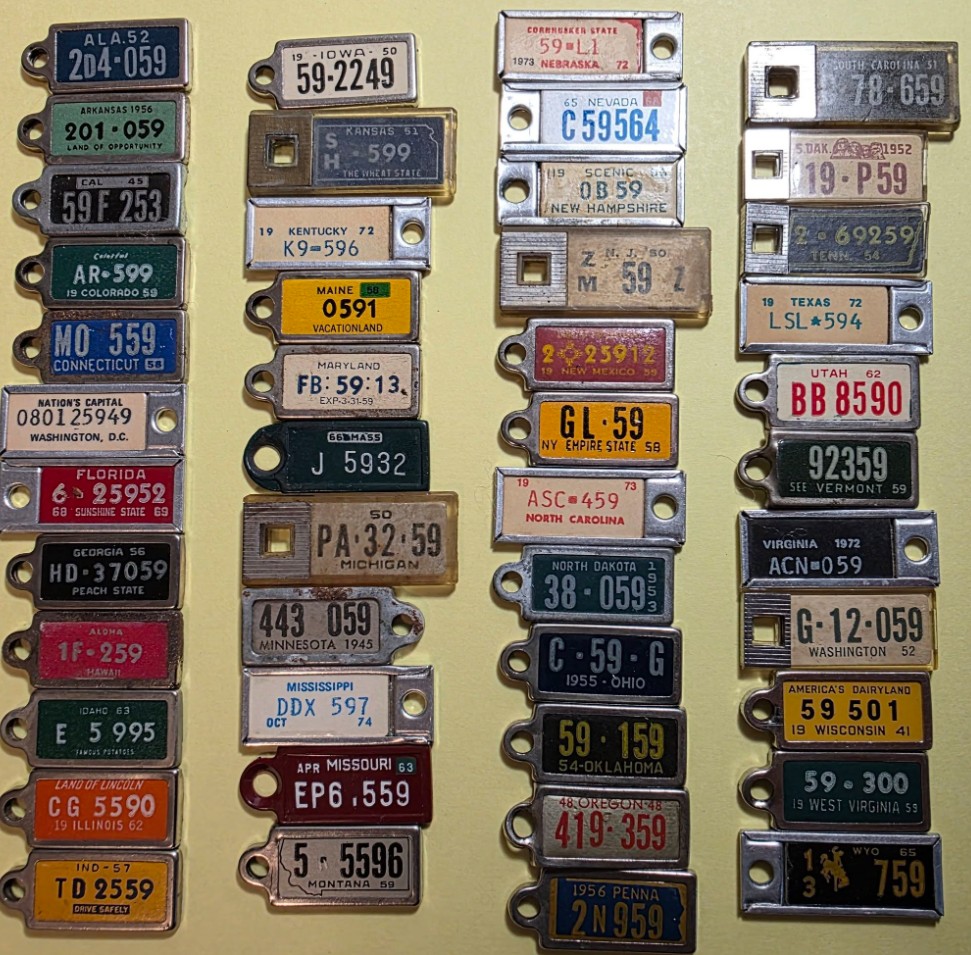
During the 1940s, another issue bears significance and warrants mention in this document, even though it is outside the scope of this website. The Disabled American Veterans of the United States and The War Amps of Canada created small keychain tags of real license plates and sent them out as fundraisers in the mail to entire jurisdictions of vehicles. Up to tens of thousands of these keychain tags were given out annually in mailers hinting for a donation to the organization. This practice flourished through the 1950s and 1960s but came to a close in the 1970s. Because they were not premium items in products or trading cards, they are not considered for this website, even though they are rather closely related. Keychain tags are quite popular with collectors and can sell in a range from a dollar to over a thousand dollars, depending on rarity.

The next issue in the run of mini license plate items came a decade after the Goudey cards, in 1949, with Stop & Go gum cards issued by the Topps Chewing Gum Co. of Brooklyn, New York. These cards were among the smallest mini license plates ever made, at 1 7/16 inches by 7/8 inch each. They had colorful representations of license plates on the front and either a factual trivia question about the jurisdiction represented by the plate image on the front or a challenge to name a car by its badge emblem. The question was exposed when the card was new, with a scratch-off answer in visual form covering about two-thirds of the back of the card. Topps repeated the set in 1950 using the same back designs but changed the size to more than twice that of the 1949 issue and used a black border around the license plate images on the front.
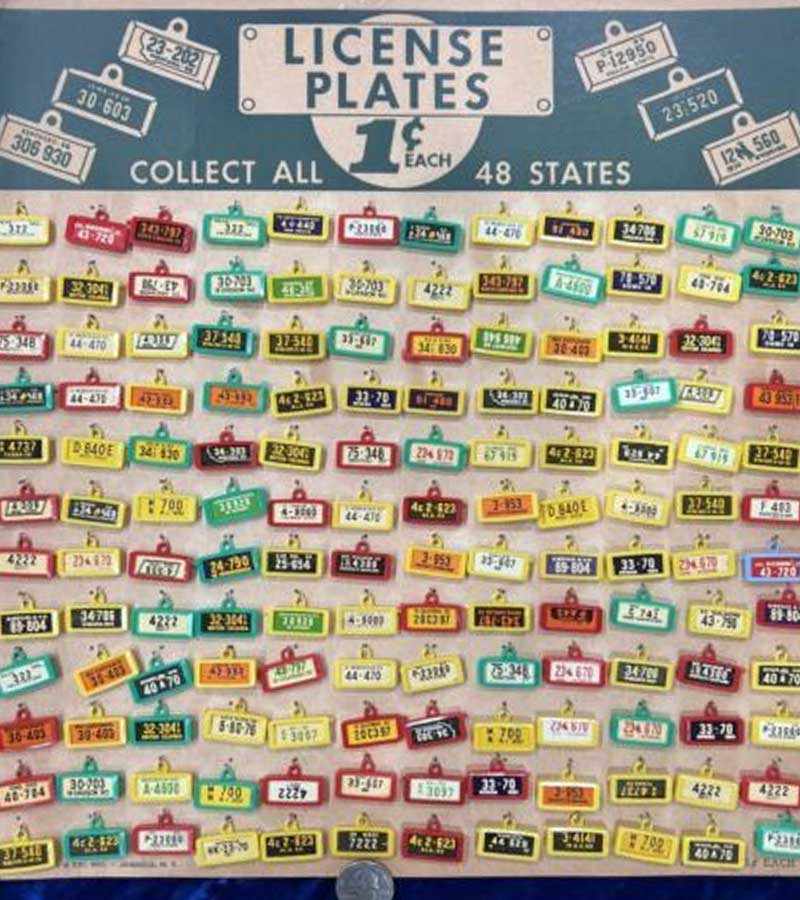
These small plastic license plate charms are a 1951-era penny vending machine issue, sold one at a time through the same type of bulk machines that dispensed gumballs, rings, and small toy prizes. They were most likely made by Samuel Eppy & Co. / Eppy, the largest gumball charm producer of the era. The original display card advertised “License Plates — 1¢ Each” and encouraged children to “Collect All 48 States,” a phrase that places the concept firmly before Alaska and Hawaii became states in 1959. Each charm was molded in plastic with a small hanging loop at the top, allowing it to be worn, linked, or saved as part of a collection.
These were not cereal premiums in the usual sense, nor were they full-sized bicycle plates or mail-order giveaways. They were inexpensive novelty charms meant to attract repeat purchases from children at drug stores, five-and-dimes, grocery stores, arcades, and similar locations. The buyer likely did not choose a specific state, which made the collecting challenge part of the appeal. While the exact maker is not confirmed from the display card alone, the format fits the mid-century gumball charm industry, where companies produced large runs of small plastic novelties for penny vending machines. Today, surviving examples are desirable not only as miniature license plate collectibles, but also as artifacts of postwar American vending culture.
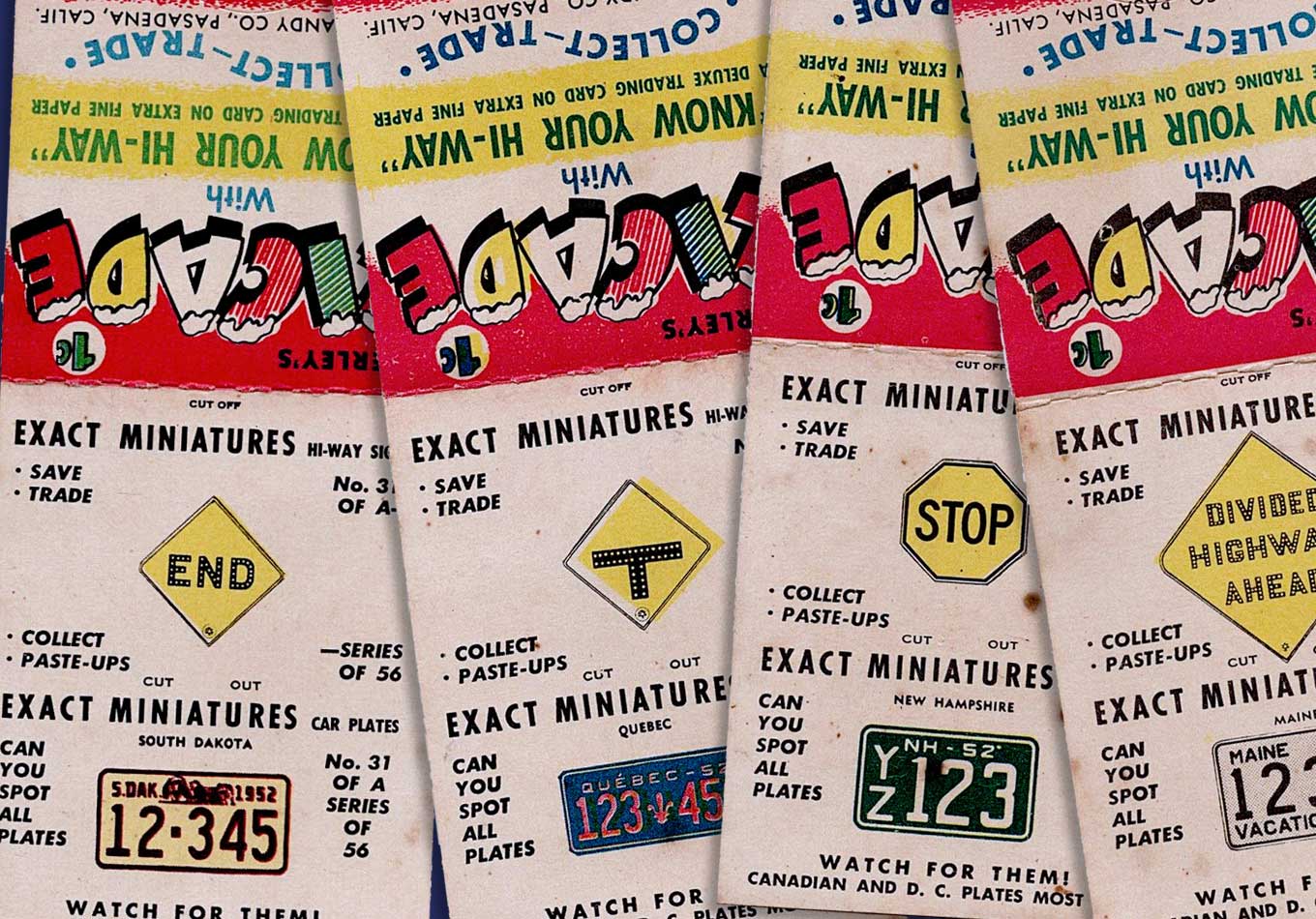
In 1952, a set of 56 folded candy covers for packaging included "Know Your Hi-Way" road signs, and each came with information for a license plate from a state or Canadian province. These are quite difficult to find and warrant rather high prices, considering they are candy wrappers. Not much is known about the history of the company that made these or whether they may be related to any other known license plate collectibles.
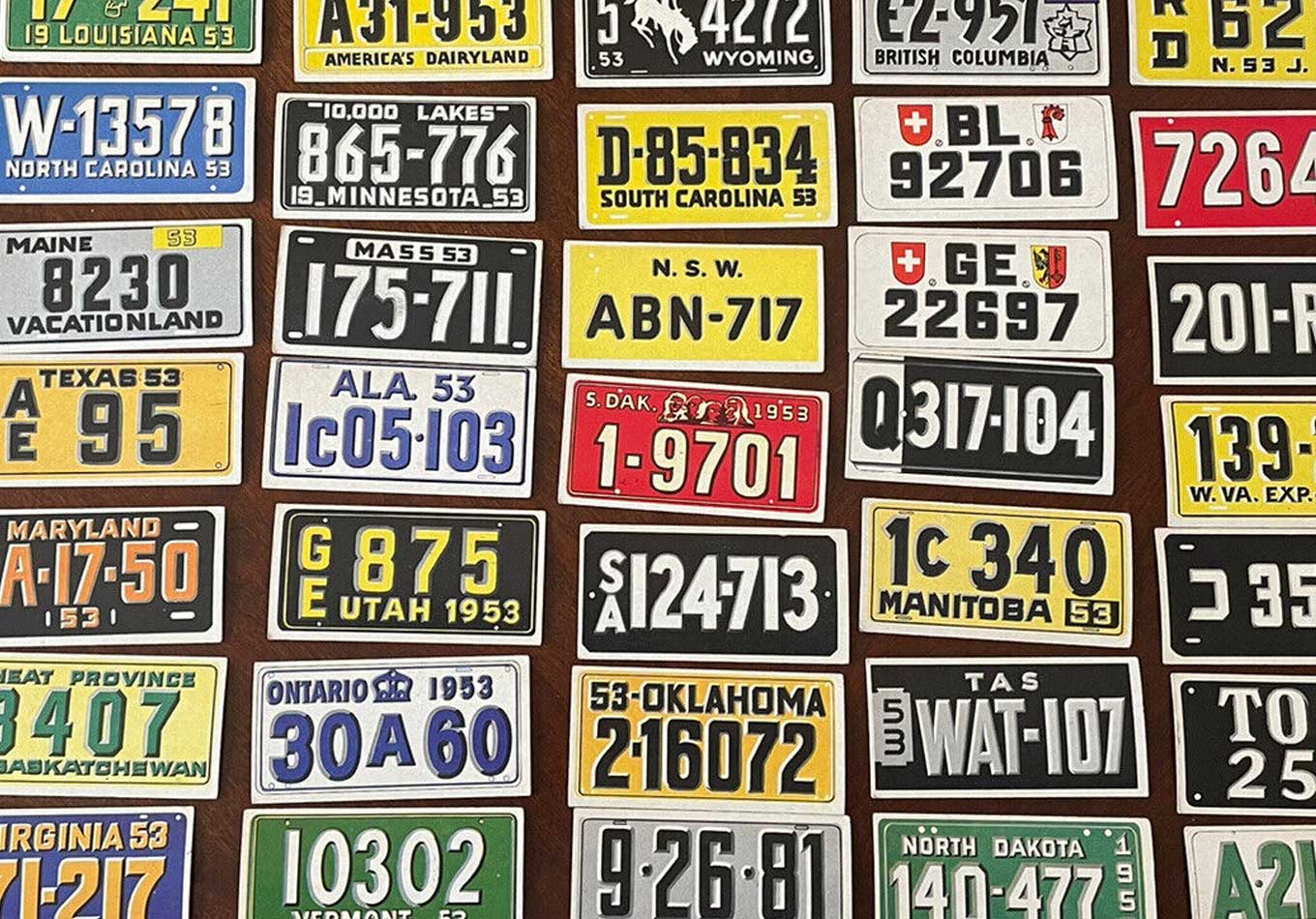
1953 was the "floodgates" year for mini license plate collecting. Starting with the lesser of two giants, Topps issued another set of cards, this one not related to their two-year Stop & Go set run. These cards were advertised as trading cards and sold in packs to collectors in the USA and Canada, and they included a stick of gum. The difference here was that the cards were the subject more so than the gum. These colorful cards are in a set of 75 showing license plates from all over the world. The back of each card includes a hint about the capital city of each jurisdiction, with the answer written backward in cursive and with the objective of holding the card to a mirror to read the answer. These cards were very popular, as they are still readily available and sell for prices as low as a dollar each.
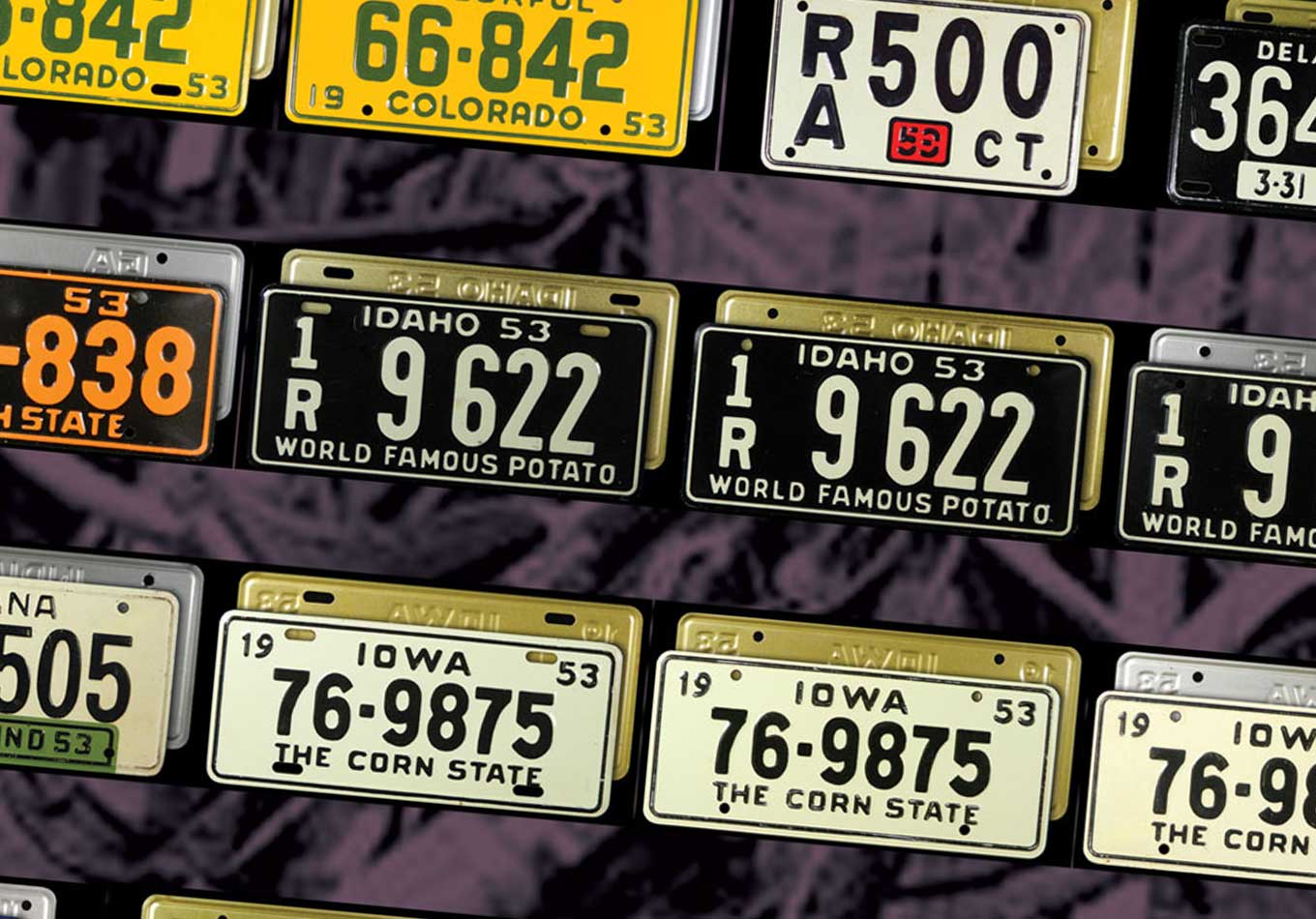
The second giant from 1953 changed the world of collecting license plate-related items. General Mills included embossed metal and full-color mini license plates with Wheaties cereal. These plates were manufactured in the millions by J. L. Clark Manufacturing Company of Rockford, Illinois, which ran extra shifts and changed tooling in the factory just to accommodate the huge order of little license plates by the cereal giant.
The design on each plate closely mirrored the passenger issue for each state (except Illinois, which was a truck plate number). The plates were flat-edged, but were embossed like the real plates and printed in up to 5 colors. The plates for Maryland, Missouri, Wisconsin and Washington D.C. were dated 1954 because those states had early expiration dates and cars displayed the next year (by expiration) for most of the current year. MANY people selling the 1953 (and 1954) Wheaties license plates often couple the 1954 dated plates with their 1954 plates, but actually belong in the 1953 set.
The plates were first affixed with glue to the outside front panel of the cereal box. This practice was abandoned before midyear because a large number of these boxes were vandalized by kids tearing the plates off the boxes in stores, leaving the boxes to sit unpurchased. The boxes were changed to include a plate inside by the end of May. Kids could also acquire the plates by sending box tops and a quarter per 12-plate set, as advertised on the back of the box and in comic book ads.
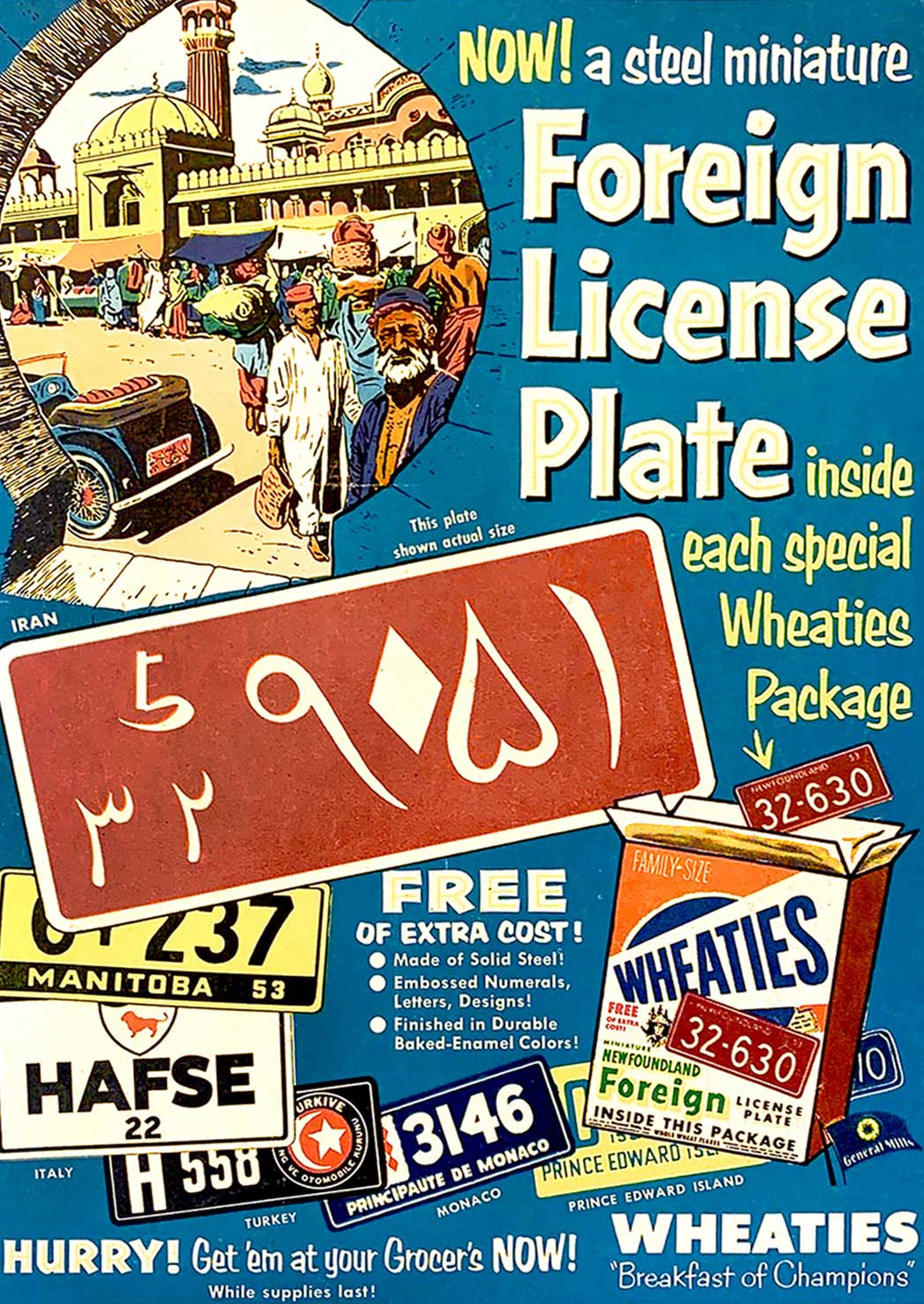
Midyear in 1953, Wheaties had foreign-jurisdiction mini license plates created as an expansion of the 48-state license plate set. These plates came in three subsets of 10 plates each, including plates of Islands and Territories, the Provinces of Canada, and the "Old World" - mostly European countries. These plates came in separate boxes from the U.S. state plates and were considered more of a second set to collect. A safety feature - crimp rolled edges on the license plates helped avoid cuts from sharp edges - likely a voiced complaint of parents. These subsets were available for a quarter as well, and both the 48-state set and the foreign plate set came with a bonus plate if all were ordered together.
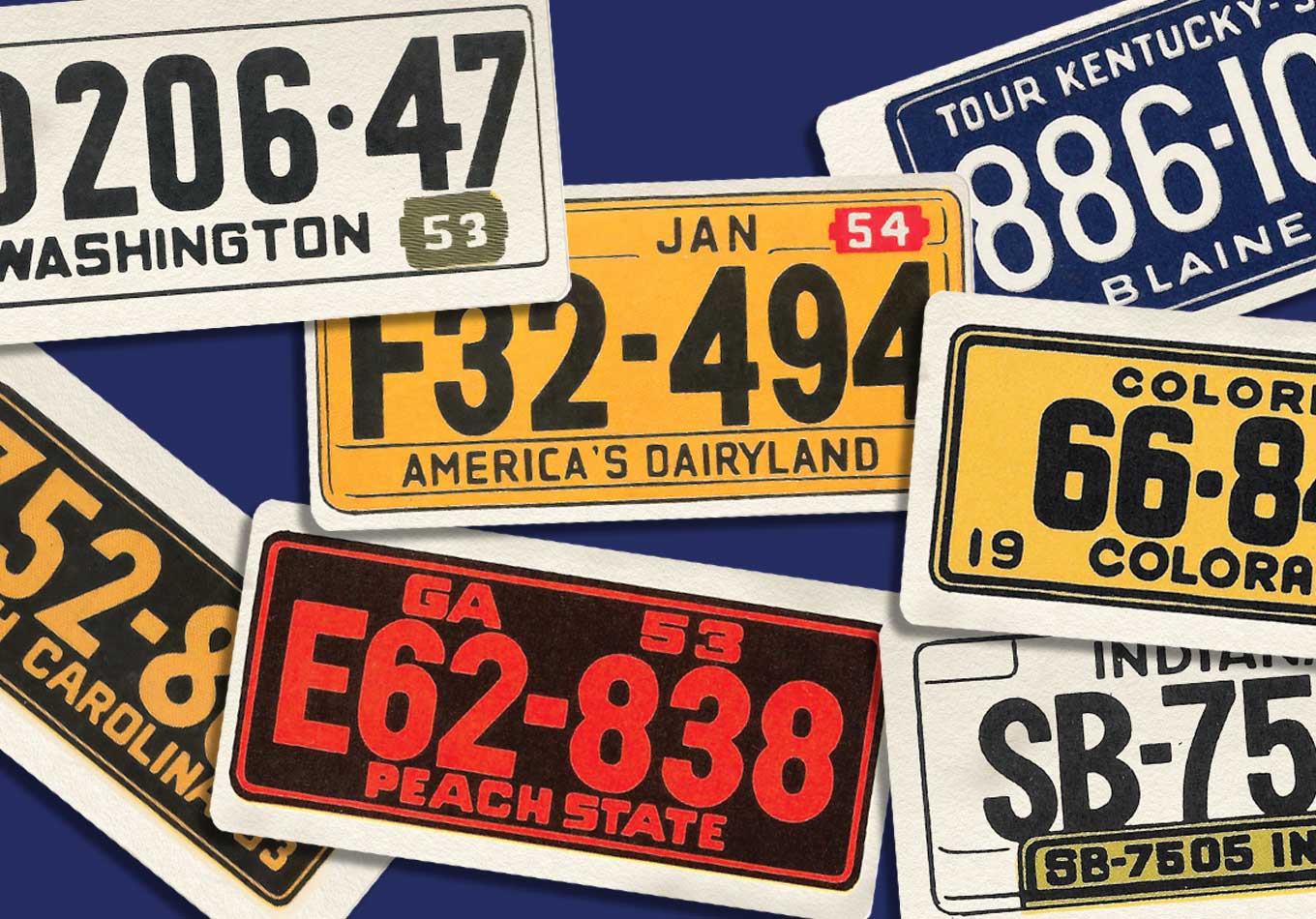
Cracker Jack, as prizes in their boxes of caramel popcorn, created a set of cards (measuring 3" x 1 1/2") featuring all 48 states in 1953. The designs on these cards are highly similar to the Wheaties license plates for 1953 featuring, in some cases, the exact same serial number - a direct copy, possibly because the states had given unusable serial numbers to General Mills to use for their plates, Cracker Jack may have acquired the same permission with the same serial numbers. This set of plate cards was repeated in 1954 with new plates and serial numbers. The set for 1953 is very rare, with only a few examples known of most of the cards. The 1954 set is even more rare - nearly half of the states are unknown in any collection today, although it is believed that all 48 states were originally represented.
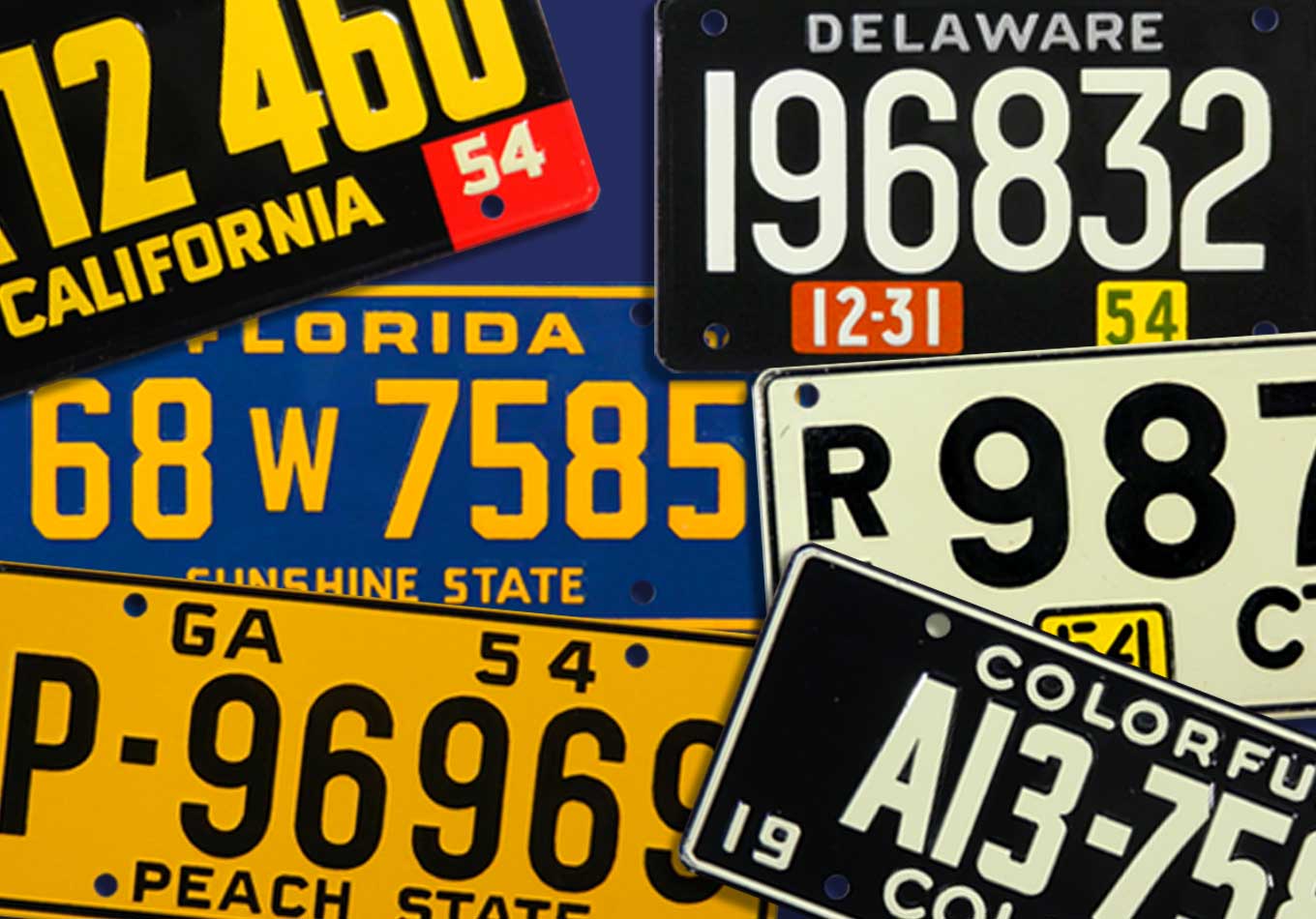
General Mills returned in 1954 with a second set of steel license plates that mirrored its effort with the USA set in 1953. All 48 states were available (with rolled edges), and kids could get a plate showing the District of Columbia if they ordered the complete 48- plate set at once for a dollar. The difference this year was that there were no additional plates designed. The 1953 foreign plate set was carried over into 1954 with no changes. It is believed that General Mills ordered so many of these foreign plates, all after the middle of the year in 1953, that there were plenty of leftovers to last all of 1954.
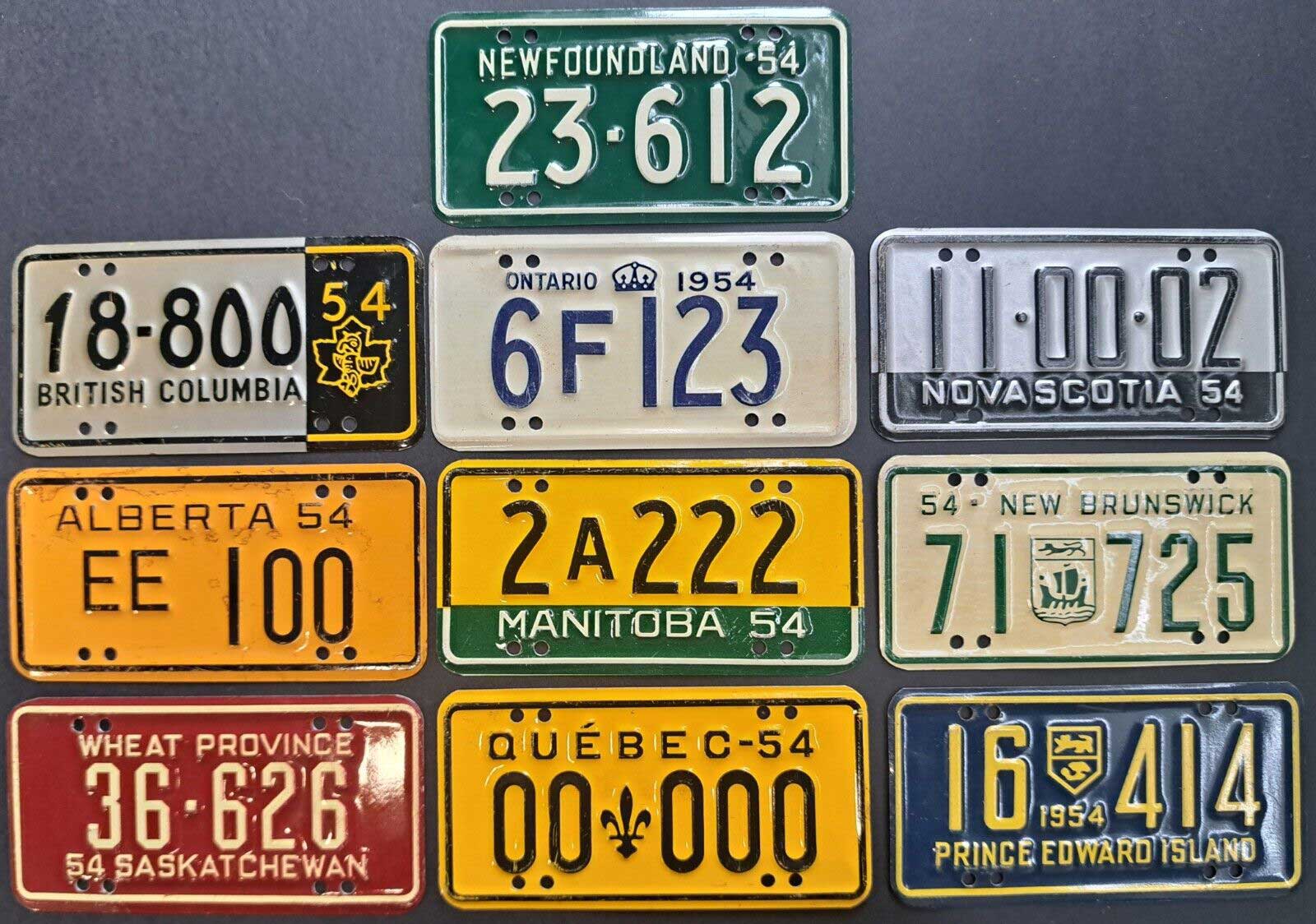
Because there were no 1954 Canadian plates issued by General Mills, another brand, Quaker, made and issued a 10-plate metal set in Canada for its Wheat Puffs cereal.
These plates were of lower quality but gave Canadians what it seemed General Mills would not. They are especially distinguishable from Wheaties plates in that they come with pairs of holes at all four corners of the plate. In error the Saskatchewan plate came in both red (the correct color) and green. It is unknown who made these plates for Quaker.

In 1955, General Mills dropped the license plate promotion and went on to other projects. The only known set issued that year was by a candy confectioner in Brooklyn, New York, called Leader Novelty and Candy Co. Because more than 70 years passed between the manufacture of said plates and the beginning of true research into the subject, very little is known about these very elusive mini license plates.
It is believed they were manufactured by J. L. Clark, the same company that had made the General Mills Wheaties plates for the past two years. They are steel, of the same gauge as the Wheaties plates. They share nearly identical art with the 1954 Wheaties plates except for a rough change of the year date and design elements where needed to match 1955 issues, and they were hole-punched for use on bicycles - sometimes only two at the top of the plate, and sometimes a hole at each corner.
Notable differences between the Leader plates and Wheaties plates are that the Leader plates are all the same size, they are not embossed except for faint border embossing on some issues, and they are all printed in only two colors, versus the up to five colors of the Wheaties plates. Assumably, all of this was a cost-cutting measure to make the order for said plates less expensive for Leader.
Very little is known about their distribution except what the boxes say; which alone is a mystery. The art on the boxes say there are 60 plates in a set, and appear to have a plate for Hawaii and another for "USA." So far neither of those are known to have ever existed. It is assumed because of the aforementioned facts that the Leader set contains the exact same number of plates as the 1954 General Mills set: 49. All of the Leader plates are rare, with a few seeming not to exist because of a lack of any knowledge of a collector having one. Fewer than a dozen of most of the plates are known to exist today.
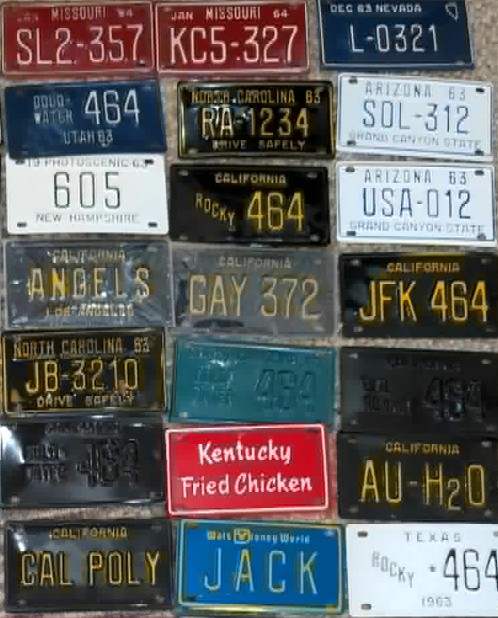
Dime Store Plates are roughly 4-inch by 2-inch mini license plates that were packaged and sold in stores between 1957 and 1964. A number of different issues and variations are known, and there are probably twice that number not known. They are known to display normal license plate serial numbers, political campaigns, amusement parks, names of boys and girls, and a number of other subjects,
They are an interesting collectible, but it is possible that one would go broke trying to acquire every different example, let alone undertake the daunting task of cataloging them. To my knowledge, nobody has even tried it.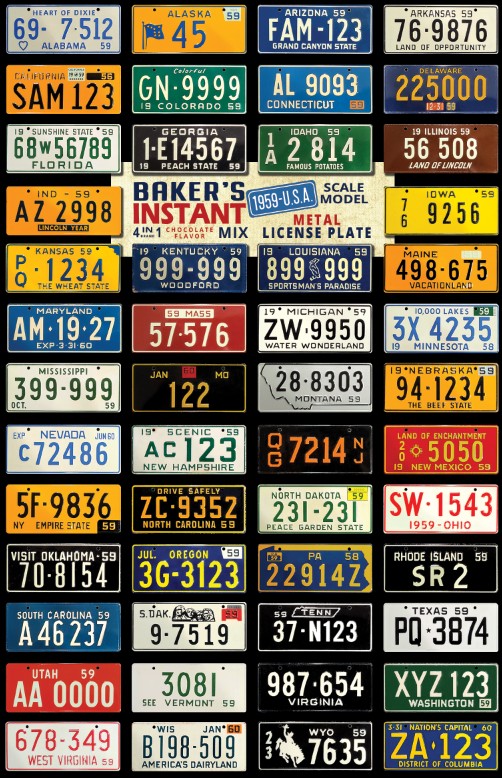
The next notable item is a 50-plate set from Baker's Instant Chocolate in 1959. This set had all 49 states (Hawaii was not yet a state in early 1959, but Alaska was), plus the District of Columbia. These plates were made by J. L. Clark Mfg. Co. and are of better quality and seem to be more accurate in appearance than the previous metal sets from 1953-1955.
Known commonly as "Baker's Plates," these were distributed with packages of instant cocoa mix wrapped in their own sealed wax envelopes. Collectors had the opportunity to order 5-plate subsets, lettered from A through J, for a quarter from the distributor. Mail order sets came in a specially marked envelope. These plates are not highly uncommon but can be a challenge to find.
We know these to be manufactured by J. L. Clark because there are two plates from this set displayed under the company exhibit in the Midwest Village Museum in Rockford, Illinois. This also helps add to the suspicion that the Leader Candy plates of 1955 were also made by the same company because all known steel plate sets (prior to those of Post beginning in 1968) of major distribution quantities are known to have been manufactured by J. L. Clark except the 1955 Leader set (for whom we have no evidence of manufacturer.)
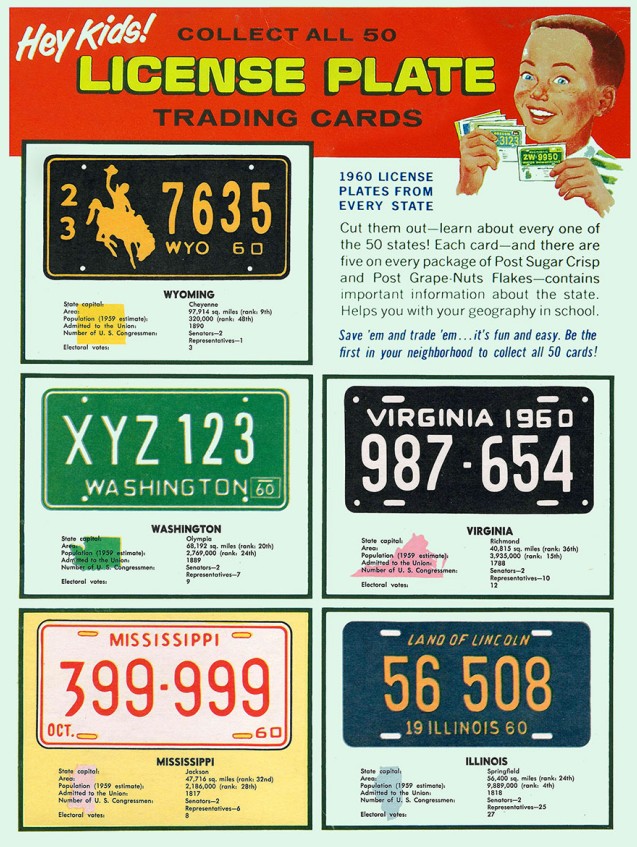
The General Foods Corporation (Post Brands) entered the market officially in 1960 with a box-back set of cut-out cards featuring the license plates of all 50 states. This was the first set of plate-related collectibles issued to feature all 50 of our current states, as they were the first known issue of mini license plates since Hawaii was added as the 50th state in August of 1959.
The cards came five to a panel (10 panels in a set) and had thick black outlines to give some room for uneasy hands cutting the cards out. They are blank-backed and printed on cereal box stock (the back of the actual cereal box).
While the cards themselves are common and rather easy to find, the intact panels from the back of the cereal boxes are quite rare and very difficult to find.

In 1961, Topps Chewing Gum became involved in its first and last set of license plate stickers. They were issued in a set of cards sold in packs featuring sports cars. The card set contained 66 subjects, and the sticker set featured American license plates and numbered 40 to a complete set. The secret was in their distribution. Twenty of the stickers were distributed in the United States by Topps. The other 20 stickers were distributed by O-Pee-Chee, the Canadian partner to Topps. This meant that the full set of 40 was a huge challenge for anyone not living close to the international border. The cards are rather common. The add-in stickers are rare!
An additional feature of these stickers adds to their rarity. Each sticker came one to a pack in the cards for a nickel a pack. The stickers had tear-off tabs, like a ticket stub, with instructions for the collector to remove the tab, and most did. Finding the stickers with their original attached tabs is quite rare, especially for the Canadian-issued stickers.

General Mills entered the paper-related license plate collectible market in 1963 with a set of 61 different license plate stickers of the U.S. states, Washington, DC, and the Canadian provinces. These 4- inch by 2-inch stickers mimicked the reflective nature of most current regular-issue plates of the time by adding a coating of tiny glass beads to their surface to make them semi-reflective. They are not difficult to find, yet many of them are faded or have yellowed due to age and the apparently acidic nature of the paper on which they are printed.
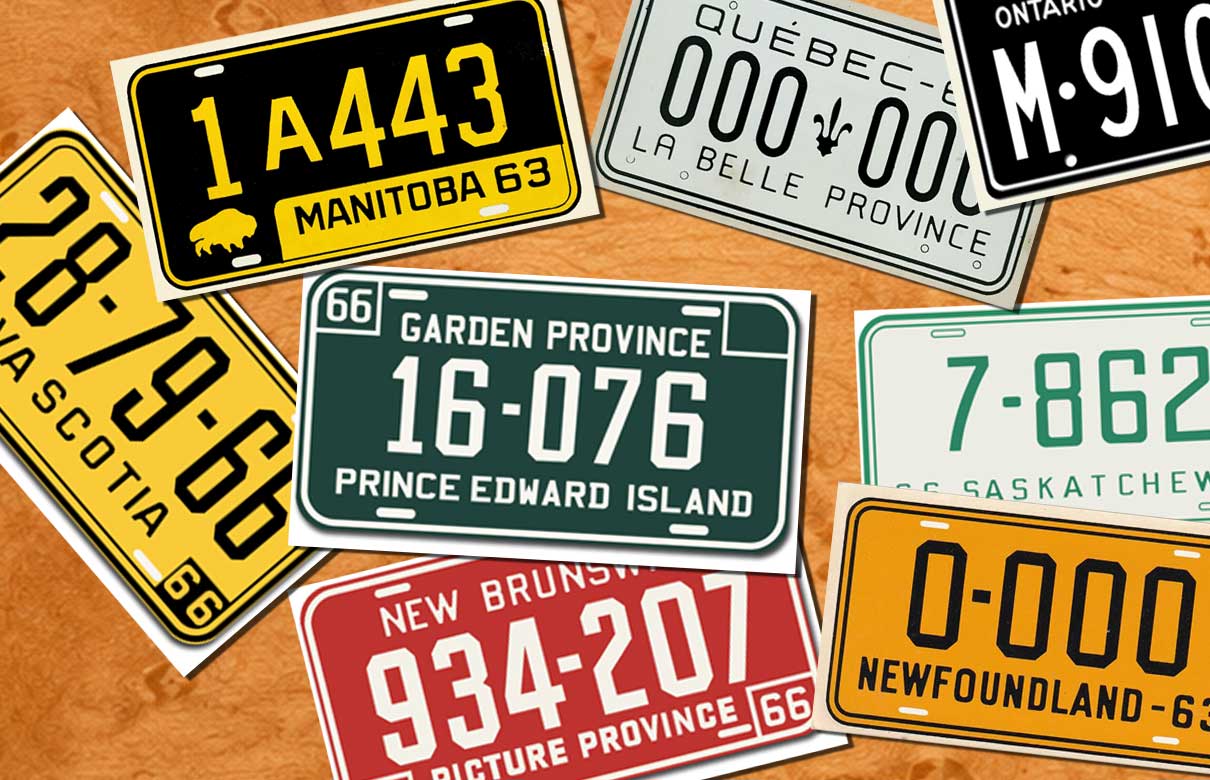
General Mills also made decal-like stickers of the 1963 license plates of the provinces of Canada and issued them in their cereals distributed in Canada only. They would eventually repeat the effort in 1966 with another nearly identical set of stickers distributed in the same manner.
They are all very scarce, and a complete set is very difficult to obtain in either case. In fact, there are a number of American collectors who are unaware these collectible stickers ever existed.

Quaker cereal put thick and heavy metal mini license plates in their boxes of Life cereal in 1968. This ten plate set could be ordered as a whole or obtained individually from boxes of cereal. It features three "antique" plates (DE, IL, and MA), four "current" design plates (DC, IL, NY, and TX), and three plates featuring NASA, the U.S. Air Force, and the U. S. Navy (sorry Army, you don't count I suppose). The plates all had holes at all four corners for easy and secure bicycle mounting.
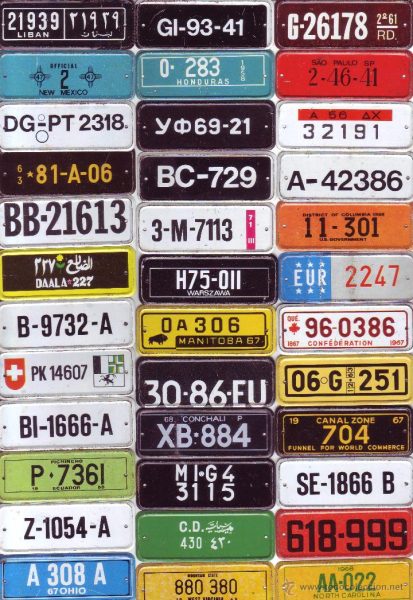
The largest set of metal license plates by quantity considering varieties would also be issued beginning in 1968. Maple Leaf Gum of Amsterdam, Holland, issued a set of 76 small tin plates measuring 2 3/4" x 1" each.
These plates showed designs from countries all over the world and remain today the most varied worldwide set of miniature license plates ever issued. While their history and purpose is a bit of a mystery, what is known is that the product itself had to have been licensed to a number of companies, because these plates can be found with at least one dozen different back designs from a flurry of different products: gum, chocolate, cheese, and other products and are known to come from a number of different countries.
Between the 76 different plates and the 12 different known backs there are nearly 650 different varieties of similar plates. Good luck on this one.
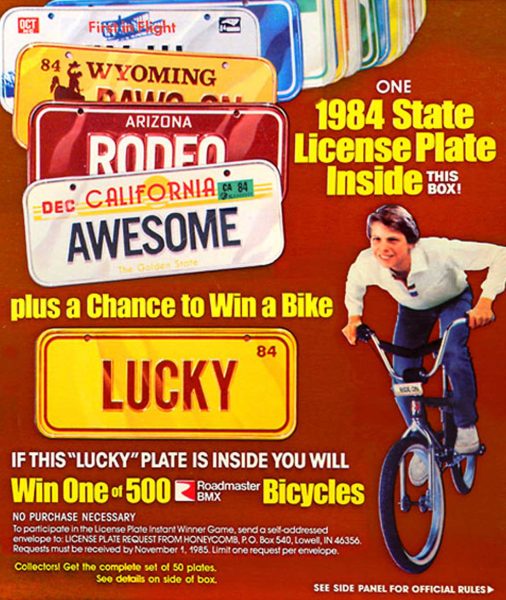
The next era of small collectible license plates began in 1968. General Foods created a set of 50 license plates of the U.S. states and issued them one per box in their kid's cereal line by Post. This set of 50 plates would be the beginning of a run that lasted 22 years with few gaps through 1990.
Years in which there were no Post plates are: 1971-1974, 1976-1977, and 1985. Why those years were skipped is a mystery, especially in the case of 1985. Each plate measured 4 7/8" x 2" which became the standard size of all their issues to follow.
All of the Post sets are rather straight forward with 50 plates representing all the states. A few varieties are known to exist as shifts in color or different patterns of embossing, such as embossing state legends on some, and not on others of the same apparent issue. The reason for this is a complete mystery.
The first three issues (1968, 1970 and 1975) of Post cereal plates are rather scarce, with the 1975 issue being the most difficult to collect. With the next issue in 1978, millions of the plates were produced thus are generally common and easy to obtain. 1987 is the exception to this general theme. The reason they are scarce is that every other issue from 1978 forward were available as complete 50-plate sets for a small fee and some box tops. There was no such offer for 1987 plates. Every single plate out there had to come from a box of cereal, so collecting a set was - and still is - a pretty daunting challenge.
Another oddity about the 1987 plates alone is that the entire set of 50 plates is undated. This creates a large amount of confusion among passive collectors or others who see them. There is no indication that they are from 1987, so many mistake them for plates from a different set. Collectors who do know what the 1987 set looks like can obtain an occasional bargain by knowing what to look for in mixed lots of plates and find the lots containing 1987 plates.
